Service
I provide practical social compliance and responsible sourcing support to brands, buyers, international audit and consulting organizations, and manufacturing suppliers, with a primary focus on China.
My work ranges from independent supplier assessments and local field support to separately scoped advisory work on social compliance, living wage and supplier-level human rights due diligence.
I focus on understanding the actual situation, identifying what matters and helping clients take practical action.
Social Audit

A social audit should be based on the requirements that actually matter to the client.
If you have your own Code of Conduct, customer requirements or social compliance criteria, I can conduct an audit against those requirements and provide an independent assessment of the supplier's actual conditions.
If you do not have a specific standard, the assessment criteria can be agreed in advance with reference to internationally recognised requirements, such as SA8000. The work may cover labour and human rights, working hours and wages, health and safety, freedom of association and management systems. This is an independent assessment, not SA8000 certification or a substitute for an authorized certification audit.
The audit approach can be adapted to the purpose of the assessment — whether it is a supplier evaluation, customer requirement, risk assessment or general understanding of workplace conditions.
I place particular importance on evidence and worker perspectives. An audit should provide a realistic picture of what is happening at the workplace, rather than simply confirm that the required documents are in place.
Suitable for: Supplier evaluation, a customer requirement or a focused review of workplace conditions.
Work: Document review, worker interviews, management discussions and on-site observation against agreed criteria.
Deliverable: A written account of substantiated findings, evidence limits and matters needing follow-up.
Scope limit: Criteria, sites, reporting format and any scheme-specific authority are agreed before the assignment; no certification or outcome is guaranteed.
Local Field & Project Support

International audit, consulting and human rights due diligence teams may need someone in China to carry out defined fieldwork and keep a project moving locally.
I can conduct worker interviews, verify supplier-level evidence, join site visits and coordinate with local suppliers and project teams. The work follows the client's agreed methodology, confidentiality requirements and reporting arrangements.
Suitable for: International teams needing China-based field capacity or local project coordination.
Work: Defined interviews, evidence checks, site-level follow-up and communication with local stakeholders.
Deliverable: Field notes, verified evidence, findings or progress updates in the agreed format.
Scope limit: I contribute to the assigned fieldwork and analysis; overall project decisions and any scheme-specific authority remain with the commissioning team.
Living Wage

I see living wage work as a process that should start with understanding the issue and the data, before moving into commitments and implementation.
My approach is aligned with the Roadmap on Living Wages by IDH, which provides a practical way to look at the living wage journey — from building awareness and measuring the gap to developing solutions and sharing progress.
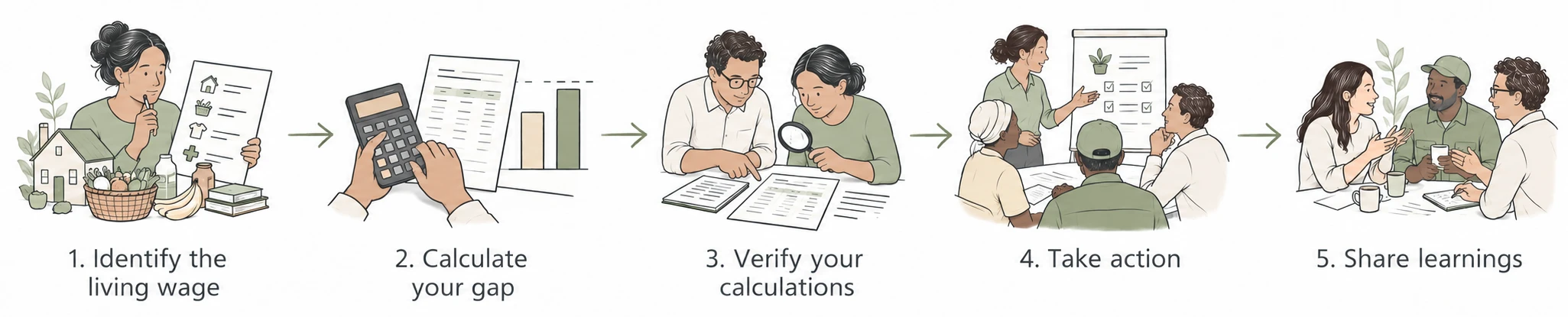
My strongest area of contribution is the front end of this journey — building understanding, measuring the current situation and helping companies make informed decisions.
I help teams distinguish between the legal minimum wage, workers' actual earnings and a living wage, and clarify what data and people are needed for a useful assessment.
The core work is to select a credible benchmark, compare it with verified wage data and calculate the gap. This can show how results differ by supplier, location or worker group, while making assumptions and data limitations clear.
Once the gap is understood, I can discuss possible ways to narrow it and their practical implications. My focus is the analysis that informs those decisions; implementation and public reporting are outside this core service.
Suitable for: Teams establishing a credible wage baseline or examining a supplier-level living wage gap.
Work: Benchmark selection, wage-data review, gap calculation and verification, and discussion of possible next steps.
Deliverable: A documented comparison, calculation review or gap analysis with assumptions and data limitations stated.
Scope limit: Implementation and public reporting require separate specialist support or a separately agreed role; a benchmark alone does not establish what workers actually earn.
Supplier-Level Support for Human Rights Due Diligence
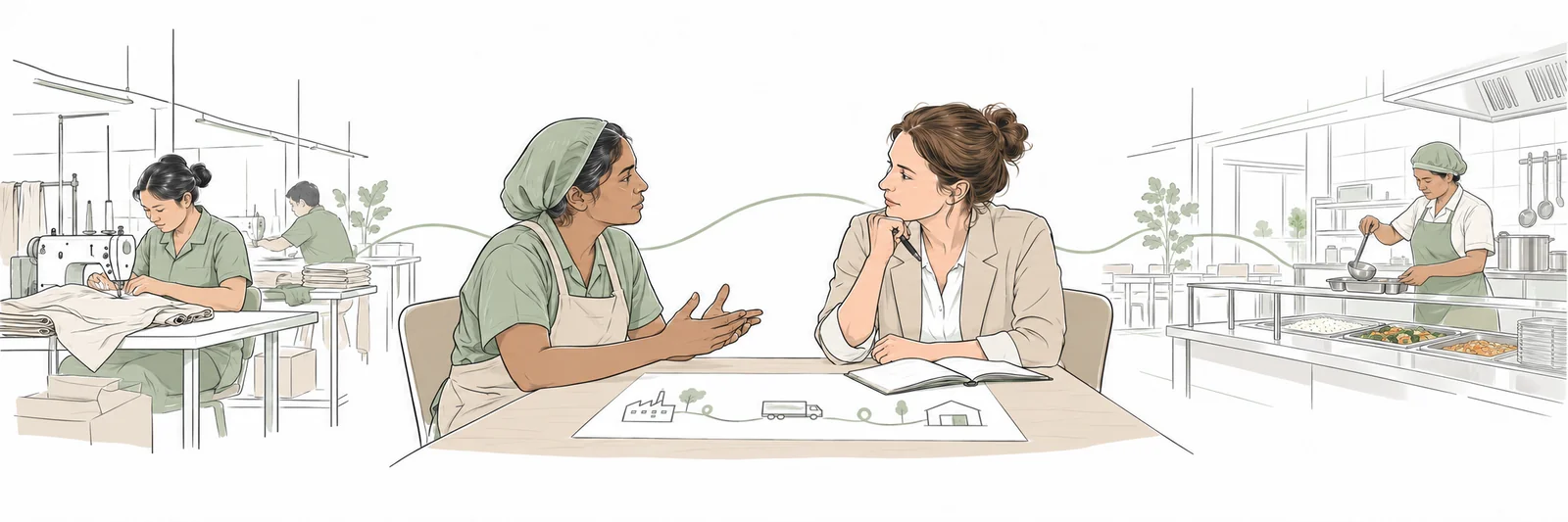
I support broader human rights due diligence assignments through factory-level assessments, worker interviews, evidence review and supplier engagement in China. My contribution is scoped to the fieldwork and analysis required by the project.
This can help a project team understand who may be affected, what the available evidence shows, where uncertainty remains and which supplier-level issues call for further attention. It does not replace the client's wider risk assessment, decisions on action or ongoing due diligence process.
For brands and buyers, the field findings can help distinguish the scale and likely causes of a supplier-level risk, so the client can decide what to prioritise.
Suitable for: Brands, buyers, audit firms or consulting teams investigating a defined supplier-level risk.
Work: Interviews, on-site observation, record review and supplier engagement under an agreed methodology.
Deliverable: Field findings and evidence-based analysis, with limitations and follow-up questions made clear.
Scope limit: I do not present this field contribution as a complete enterprise-wide HRDD system or assume responsibility for the client's overall due diligence decisions.
Tailored Social Compliance Support
Not every social compliance need fits a fixed service package. I can take on a defined role within a client's existing programme, such as local coordination, corrective action plan (CAP) verification, supplier training or follow-up across multiple sites.
For suppliers, this may include clarifying customer requirements and working with factory teams to translate them into day-to-day practice.

In one brand project, this included receiving reports from different assessment systems, translating the findings into a consistent internal supplier report, contacting suppliers about corrective actions and collecting evidence for follow-up. Source reports may come from formats such as SMETA, SLCP, amfori BSCI or WRAP; their methods and findings should remain traceable rather than be treated as interchangeable.
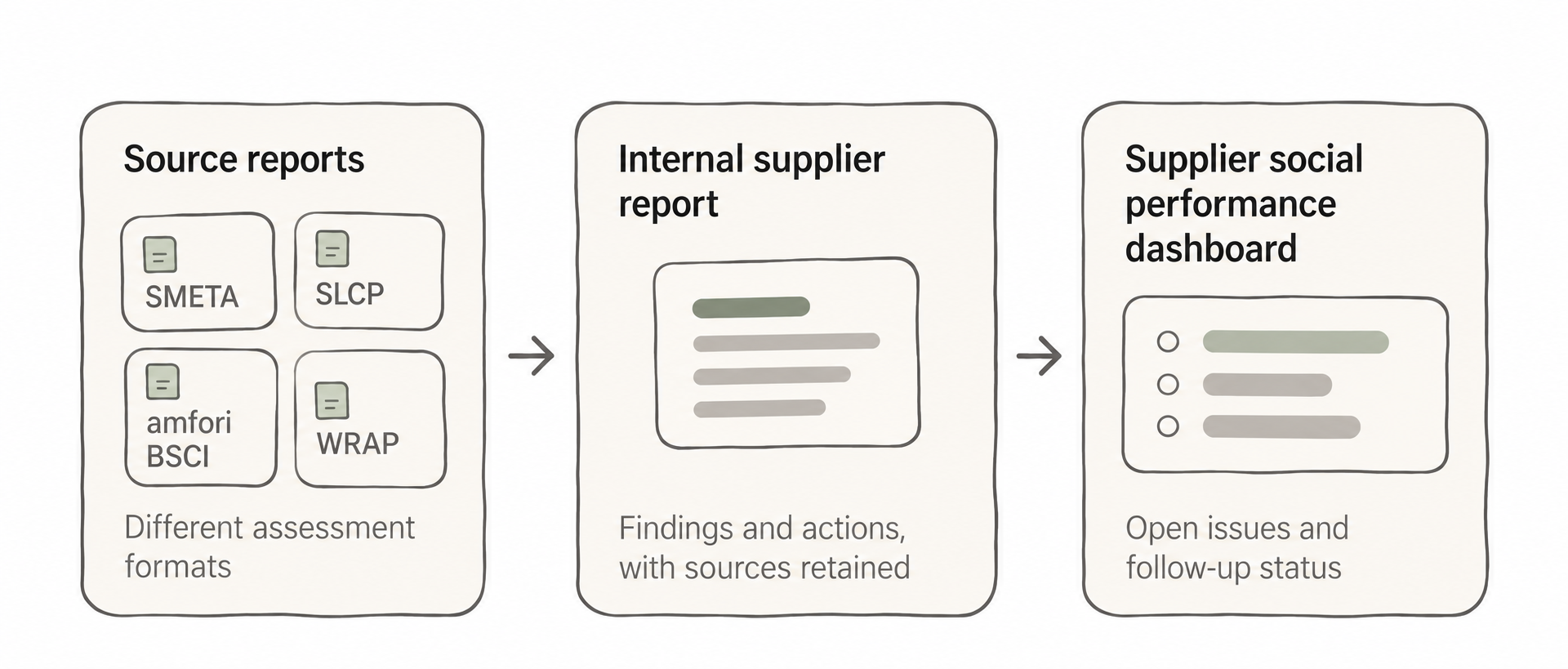
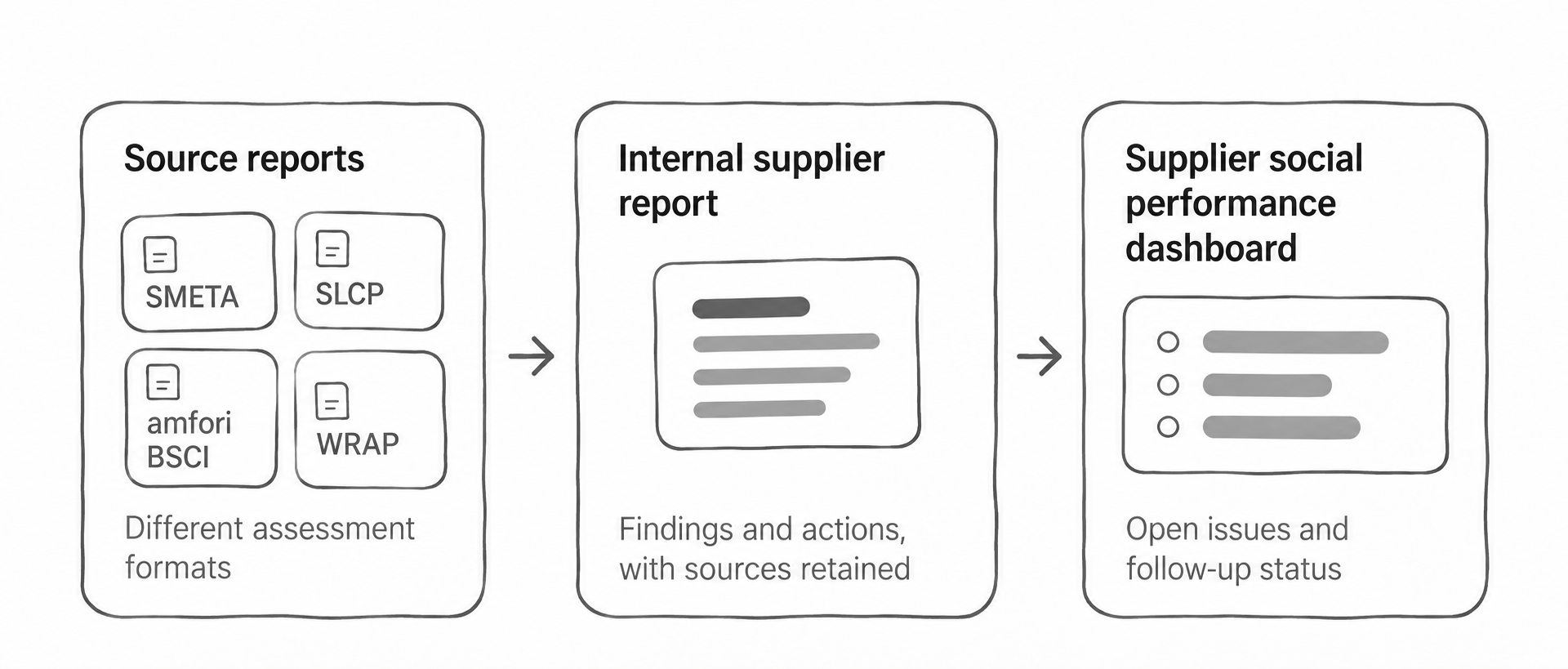
Where useful, the information can be organised in a supplier dashboard showing open findings, actions, evidence received and review status. The aim is to help the client see what needs attention and carry each agreed action through to a documented outcome.
Suitable for: Any team needing practical support within an existing social compliance programme.
Work: Agreed local coordination, report review, supplier engagement, training or corrective-action follow-up.
Deliverable: An internal supplier report, evidence review, progress tracker or other agreed output.
Scope limit: The client's criteria govern assessment and closure decisions; original report findings and evidence limitations remain visible.